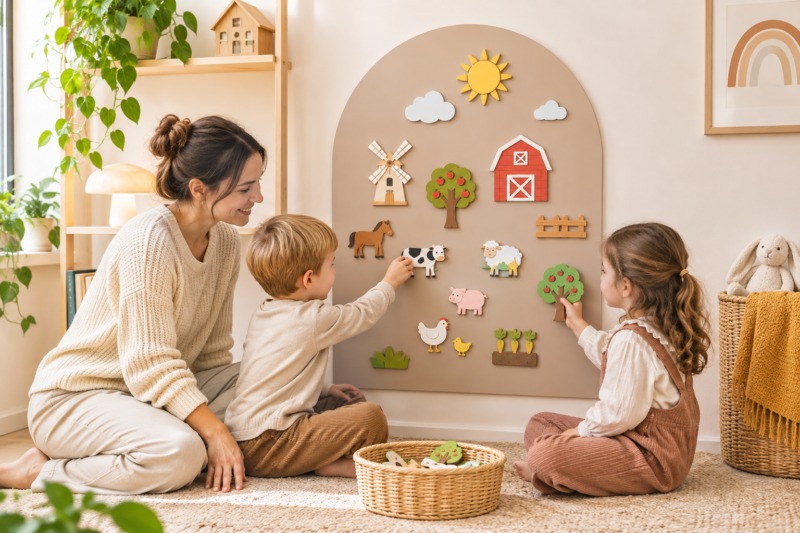
Picture-perfect playrooms are lovely, but most of us are working with a living room, a shared bedroom or a corner of the dining area. The good news is that children don’t need an entire room to enjoy creative, meaningful play. What they need is a spot that feels like theirs, materials they can reach, and enough calm to get absorbed.
With a few simple adjustments, small and unused corners can become inviting places to play. You don’t need to knock down walls or buy a houseful of new furniture. You need a little planning and a willingness to start small.
The short answer: you can build a play space without a playroom with a defined corner, a wall that does double duty, a few toys that can be played with in many ways, and a simple routine for putting things away. Here’s how, step by step.
1. Find an Underused Corner of Your Home
Walk around your home and look for space that isn’t earning its keep: the gap beside the sofa, the end of a hallway, a bedroom corner, or the area under a window. Think about where your family actually spends time. A play corner in a room you rarely use tends to stay empty, while one near the kitchen table or sofa gets visited all day.
The best spot is one where you can see your child while you cook, work or relax. Check the floor and surroundings for anything that could cause trouble, such as trailing cables, sharp edges, or tall furniture that could tip. If a bookcase is nearby, anchor it to the wall.
A small rug or a low shelf is usually enough to mark the area out. Children pick up on these cues quickly: this is where we play. A defined kids’ play corner also helps the rest of the room stay yours, because toys have a clear home to return to. If you need the space back in the evening, choose a rug you can roll up and a shelf you can tuck against a wall.
2. Make the Most of Vertical Space
When floor space runs out, look up. Walls take up no floor area, and they can hold activities children genuinely enjoy: telling stories with animal magnets, arranging letters into words, or building a little scene and rearranging it the next day. A wall can also hold things your child makes, such as a rotating display of drawings.
Because wall play happens at a child’s level, it suits shared family spaces well. It can sit beside the sofa or along a hallway and blend back into the room when playtime is over. Children can play while you chat, and you can join in standing or kneeling beside them, which is harder with a floor-based set-up in a tight room.
For families looking to make better use of their walls, Tix&Mix offers magnetic play boards and hands-on toys that can help turn an unused wall into an interactive play space.
Whatever you choose, keep wall activities at a height your child can reach comfortably, and check that any small pieces suit their age. If you rent, look for options that won’t damage the wall, and test a small area first.
3. Choose Toys That Encourage Different Ways to Play
The American Academy of Pediatrics advises choosing toys that aren’t overstimulating and that encourage children to use their imaginations. It also stresses that the best toys are the ones that get parents and children playing, pretending and interacting together. That’s good news for small homes, because versatile toys do more with less.
A set of wooden blocks can be a tower, a farm fence and a road in a single afternoon. Magnetic pieces can become a story, a pattern or a counting game. A few toy animals can star in a farm, a zoo or a bedtime tale, and a simple pretend kitchen can power dozens of games. Wooden puzzles are more structured, but they’re compact and reward repeat play as children get faster and braver.
When you’re deciding what to keep, ask: can this be used in more than one way? Aim for a handful of toys that can be played with several ways, rather than lots of single-purpose items that each need their own box. Fewer, more flexible toys mean less clutter and often more imaginative play.
4. Keep Everything Within Your Child’s Reach
Low shelves, baskets and open storage let children see their choices and pick something without asking for help. Early childhood environment-planning guidance describes this kind of set-up: a low shelf with safe materials attractively displayed and available for children to use, plus somewhere to show their creative work.
This is the heart of Montessori-inspired thinking, and it doesn’t require expensive furniture. A low bookcase, a stack of sturdy crates, or a few baskets on the floor will do. The aim is simple: your child can see what’s on offer, choose it, and put it back.
Try getting down on your hands and knees to see the space from your child’s height. You may notice that favourite toys are hidden behind others, or that a basket is too heavy to lift. Small changes, like fewer items per basket or a lighter container, can make a big difference to how independently they play.
5. Create a Comfortable and Inviting Atmosphere
A soft rug, natural light and a few simple decorations make a small space feel welcoming. If you can, place the play corner near a window, so daylight does some of the work and the area feels open rather than tucked away.
Try not to over-fill it. Too much visual clutter can make a compact area feel busy, while a calm, uncluttered corner invites children to settle in. Keep decoration simple: a framed print at their eye level, a plant that’s out of reach, or a basket of books.
You don’t need to buy anything new. A cushion from the sofa, a basket you already own, or a throw blanket can make a corner cosy. Children tend to respond more to a space that feels warm and uncrowded than to one that looks styled, so use what’s already in your home and add things slowly.
6. Rotate Toys Instead of Adding More
Toy rotation is one of the most practical ways to manage limited space. Keep a small selection out where your child can reach it, store the rest out of sight, and swap a few items every week or two.
There’s some research behind the idea. In a small University of Toledo study, researchers gave 36 toddlers either four or 16 toys, and those with fewer toys played longer with each one and more creatively. The lead researcher cautions that the findings don’t translate perfectly to every home, and she suggests rotating toys rather than purging them to see how your child responds.
To start, pick one shelf or basket as the “out” collection and put everything else in a box or cupboard. Include a mix of toy types, such as something to build with, something to pretend with and something to look at or read. Then watch what your child actually uses. When interest fades, swap a few items. Toys that have been away for a while often feel new again, without a penny spent.
7. Make Tidying Up Part of the Daily Routine
Simple storage makes cleaning up quicker. Give each type of toy its own basket or spot, and add picture labels so children can see where things go before they can read. When everything has a home, tidying becomes a matching game rather than a chore.
A short tidy-up at predictable moments, such as before meals or before bedtime, turns it into a habit rather than a battle. Let children help in ways that suit their age. Toddlers can drop blocks into a bin or carry a basket back to the shelf. Older children can sort their own baskets, and may enjoy choosing which toys go into rotation next.
Doing it together, with a bit of music or a game of beat-the-timer, keeps it light. Praise the effort rather than the result, and don’t worry if it isn’t perfect. A little mess is a sign the space is being used.
Final Thoughts: Small Spaces Can Inspire Big Imaginations
A meaningful play area doesn’t depend on a dedicated room. It depends on accessibility, creativity and thoughtful choices about what goes in it. A rug, a low shelf, a handful of flexible toys and a bit of wall space can give children everything they need to build, pretend and explore.
Start with one small space, whether that’s a corner, a shelf or a stretch of wall, and watch how your child uses it. Then adapt it as their interests change. The best play space is the one that fits your home and your family right now.
FAQ
How do I set up a play area in a small living room?
Choose a corner within sight of where you sit, define it with a small rug, and add a low shelf or basket of toys. Rotate the toys so only a few are out at once, and store the rest in a cupboard.
How many toys should be out at a time?
There’s no magic number. The Toledo study compared four and 16 toys, and many families find a small, rotating selection works well. Watch your child and swap items when interest fades.
What are good toys for a small-space play area?
Choose open-ended toys that serve many games, such as blocks, magnetic pieces, puzzles and pretend-play items, rather than single-purpose toys.
Do I need Montessori furniture?
No. The idea behind it is accessibility, so low shelves, baskets and crates you already own can do the same job.
Discover more from Hello MrsShilts
Subscribe to get the latest posts sent to your email.