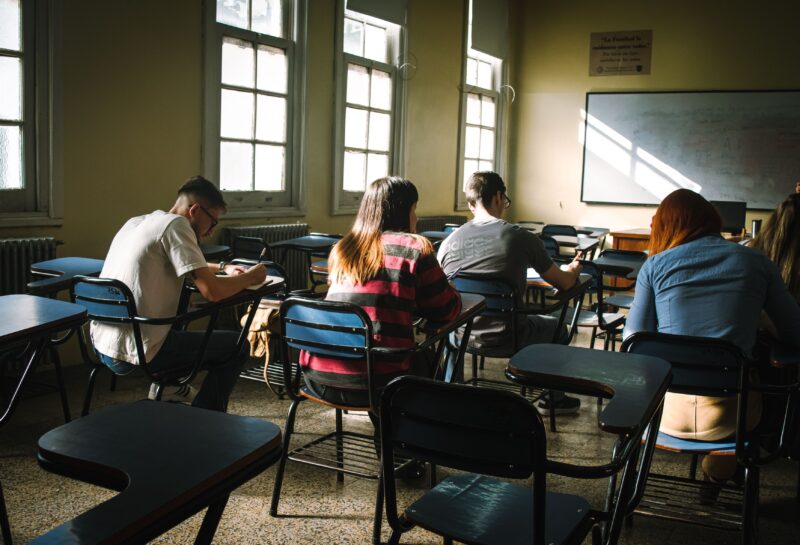
At some point in Year 9, a glossy options booklet comes home. Every subject gets a page, written by its own teachers, and every page makes the subject sound brilliant. Then there’s an options evening in a busy school hall, a form to fill in, and a 14-year-old who mostly wants to be in the same class as their friends. With one of my boys now in Year 8, that booklet will be landing on our kitchen table before long.
Most schools ask pupils to choose between January and March of Year 9, and a few start in Year 8. It’s a big decision made with very little to go on. The best extra information I know of costs nothing and takes one evening: sit down together with a real GCSE exam paper for each subject on the shortlist.
What’s already decided
English, maths and science are compulsory, so they aren’t really options. Science can be combined science, worth two GCSEs, or biology, chemistry and physics separately. The choices are usually three or four subjects from the rest.
You may hear about the EBacc, which counted how many pupils took a language plus history or geography. The government announced in November 2025 that it is being removed, so it’s fair to ask your school whether it still shapes the options blocks.
The kitchen-table exercise
Ask the school which exam board each subject uses. Then look up the most recent paper for each subject on the shortlist. The boards post them on their own websites, or you can find them sorted by subject on School.Ninja’s GCSE past papers section. Pour a drink and read one of the long questions together. Don’t try to answer it. They haven’t been taught it yet, and that isn’t the point. Look at what kind of thinking it asks for, and whether your child can picture themselves doing that in a hot exam hall in two years’ time.
Here’s what four real questions from June 2024 look like. They’re all from AQA, one of the most widely used boards.
History (Paper 1, two hours, 16 marks plus 4 for spelling and grammar):
“The main reason why the Treaty of Versailles was hated by the Germans was because of what it did to their armed forces.” How far do you agree with this statement? Explain your answer.
This is an argument. The marks go to a pupil who can weigh up several reasons and make a case, in writing, against the clock. History students sit two of these two-hour papers.
Geography (Paper 3, 9 marks plus 3 for spelling and grammar):
To what extent do you think that the Tudeley Village development will be a sustainable settlement? Use evidence from the resources booklet and your own understanding.
The same paper also asks pupils to read an Ordnance Survey map and pull figures from survey data. Geography mixes short data questions with extended writing, across three papers and just over four hours in total.
Computer Science (Paper 1, 7 marks):
Write a Python program to authenticate a username and password.
The question then lists what the program has to do, including repeating until the right pair is entered. There’s no essay here: the code has to do the job. A pupil who loves puzzles and logic will enjoy this. One who has only ever used a computer for games may be surprised.
Religious Studies (Paper 2, 12 marks plus 3 for spelling and grammar):
“Marriage is not important in today’s world.” Evaluate this statement.
Pupils must argue both sides, refer to religious views and reach a justified conclusion. It suits a teenager who likes a good debate at the dinner table, which may be more of them than you’d expect.

Four GCSEs, four very different exams: real AQA questions from June 2024
What to look for
Watch your child’s face as you read. Interest, irritation and “oh, I’d like that” are all useful information.
Some subjects aren’t mainly exams at all. In AQA’s specifications, Art and Design is 100% coursework (a portfolio and a final project). Drama and Music are 60% coursework and performance, Design and Technology and Food Preparation and Nutrition are 50%, and PE is 40% practical. That balance matters for a child who freezes in exams, though coursework deadlines bring their own pressure.

Share of the GCSE grade that comes from coursework, practical work or performance in AQA subjects
It’s also worth asking whether the school offers anything unusual. Statistics, Astronomy, Geology and Electronics are all real GCSEs, and Astronomy asks pupils to make and record their own observations of the night sky. Strong mathematicians are sometimes offered Further Maths, usually as a Level 2 Certificate alongside the main GCSE.
Other free help
For lessons rather than papers, Oak National Academy has free Year 10 lessons by subject, and BBC Bitesize is the old favourite.
Five questions for options evening
- How much homework does it set in Year 10?
- How many exam papers are there, and how long are they?
- Is there coursework, and when in Years 10 and 11 does it happen?
- Can my child change subject in the first weeks of Year 10 if it isn’t working?
- Is triple science open to everyone, or only to some sets?
A real paper won’t make the decision for you. But it gets the conversation onto what they’d actually be doing for two years, rather than which of their friends are taking it.
Discover more from Hello MrsShilts
Subscribe to get the latest posts sent to your email.