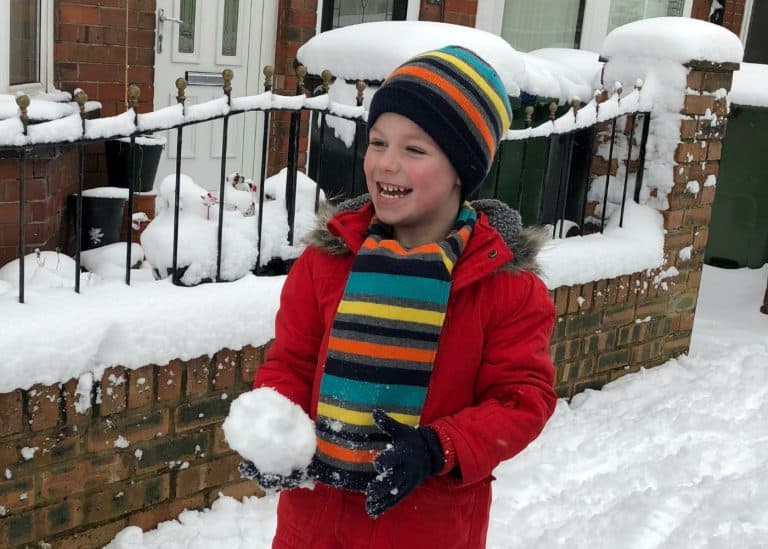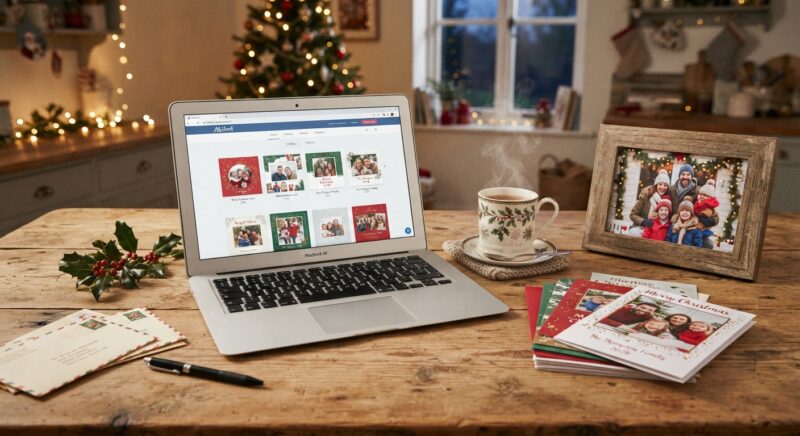
Every year I promise myself I’ll sort the Christmas cards in November, and every year I’m sitting at the kitchen table on 15th December with a cold cup of tea and a photo of the boys where one of them is blinking. Ordering online takes the panic out of it, but there are now dozens of sites, and they are not all the same. Here are six sites worth your time this year, along with what each one is actually good at.
Before you order, work out what you’re actually buying
Card sites split roughly into three types. There are photo-led services where your own picture is the design, illustrated card shops where the artwork is the point and a photo is optional, and bulk printers where the appeal is price per card once you’re ordering 50 or more.
It’s worth knowing which camp you’re in before you start browsing, because the editors behave completely differently. It’s also worth knowing that we’re still a nation of card senders. Christmas remains the single biggest greeting card occasion in the UK by volume, and by a long way, so you’re in very good company if you’re still doing a list.
The other thing to settle early is whether you want the cards sent to you to write and send yourself or sent directly to each recipient. Direct send saves hours if your list is mostly distant relatives. It’s less lovely if, like me, you want to write something in each one.
1. Mixbook
If the whole point of your card is a picture of the family, this option is the one I’d start with. The editor gives you proper control over layout rather than dropping your photo into a fixed hole, so you can nudge the crop, change the background colour, swap fonts and add a second or third photo without the design falling apart.
That matters more than it sounds. A flexible editor makes a huge difference when your best family shot is a landscape photo, while every template requires a portrait one, yet most people only realise this after uploading their images.
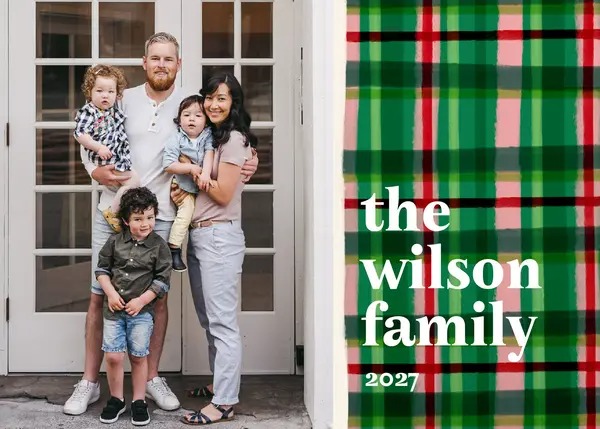
The design library leans modern rather than traditional, which suits a photo card. Plenty of the Mixbook holiday cards are built around a single large image with the greeting set small underneath, and there are collage layouts if you want a year-in-review feel with four or five photos. Foil options are available on a good chunk of the range.
For UK orders, Mixbook works with a network of local printers rather than shipping everything from the States, so you’re not waiting on international post or worrying about customs. It’s worth checking the estimated delivery date at checkout before you commit, especially in the second week of December.
The trade-off: if you want a traditional robin-and-holly card with no photo at all, this isn’t the strongest library. Head to the next one.
2. Papier
Papier is where I’d send anyone who cares more about the artwork than the photo. The illustration style is closer to a lovely independent stationer than a photo lab, and the range covers everything from proper traditional to slightly rude.
The specs are reassuringly solid too. Their personalised Christmas cards are printed on 350 gsm uncoated stock, which has a lovely matte feel and holds up on a mantelpiece, while folded cards come in at roughly 127 mm x 178 mm. Printing happens in England and next-day delivery is available, which is the bit that matters when you’ve left it late.
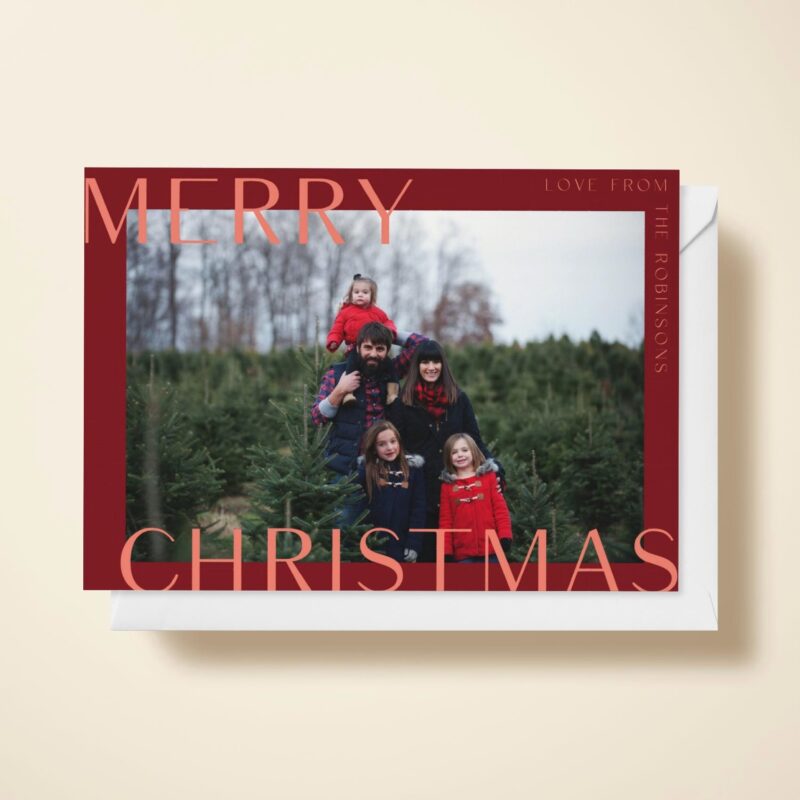
You can personalise the inside message or leave it blank for handwriting, and they can send it to you or directly to the recipient. There are photo designs in the range as well, but they’re a smaller slice of the library, so treat photos as a bonus rather than the main event here.
The trade-off: per card, the price is not the budget option. It’s the right call for 20 cards to people you actually like, less so for 80, including your husband’s entire department.
3. Vistaprint UK
When the list runs past fifty, price per card starts to matter more than anything else, and this is where the bulk printers earn their place. Vistaprint’s Christmas card range covers flat and folded, photo and non-photo, and gets cheaper per unit as the quantity climbs.
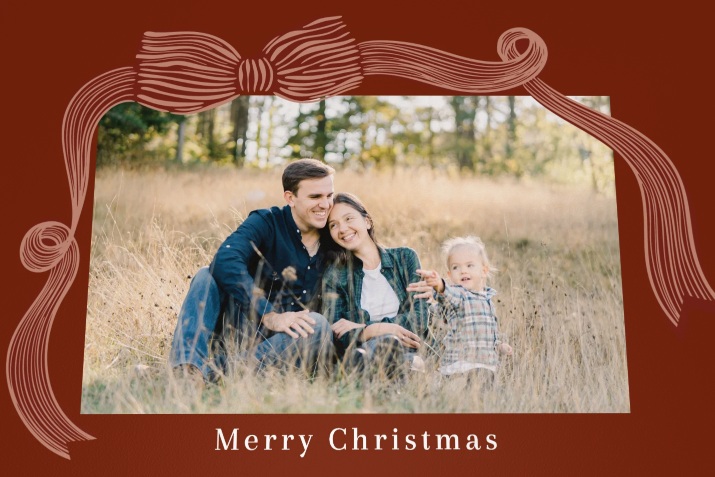
It’s also the obvious choice if you’re sending cards for a business as well as the family, because you can run a personal batch and a branded batch through the same account and the same design tools. There are premium touches available if you want them, but the real appeal is that a big order doesn’t hurt.
The trade-off: the design library is functional rather than beautiful, and the site will try quite hard to upsell you on matching bits and pieces. Ignore it and check out.
4. Moonpig
Moonpig has become the default for a reason. The app is quick, the search is good, the personalisation is idiot-proof, and the send-direct option means you can lie in bed on 18th December and get forty cards away without touching an envelope.
The design range is enormous and covers the sentimental, the funny and the genuinely quite naff, which is a compliment. If you have a relative who expects a card with a specific joke about their age or their dog, someone at Moonpig has already made it.
The trade-off is that paper quality is fine rather than special, and because the range is so huge, browsing can take longer than writing. Filter hard by category or you’ll lose an evening.
5. CEWE
If you want a photo card but you’re twitchy about waste, CEWE is worth a look. They offer a recycled paper stock printed with a water-based digital process, alongside the usual glossy and matte options, and the finish has a soft, slightly textured look that photographs surprisingly well.
The template range is broad, with folded, flat, and postcard-style options. There are also embossed text options in gold, silver, and rose gold if you want a bit of shine without going full glitter. Their editor sits somewhere between Mixbook’s flexibility and Moonpig’s simplicity, which suits people who want to tweak a bit but not design from scratch.
The trade-off: the interface is more photo-lab than boutique, and the design taste is a little safer than the independent options.
6. thortful
thortful is a marketplace rather than a print shop, so every design comes from an independent illustrator or designer, and the money goes back to them. If you want a card nobody else on your street will be sending, this is the place.
The Christmas range gets a proper refresh each year, the humour cards are genuinely funny rather than dad joke funny, and you can send them directly or have them delivered to you. Cards are printed and posted from the UK.
The trade-off: it’s card-first rather than photo-first, so it’s not the answer for a family portrait card. And because designs come from hundreds of different sellers, quality is a very slightly less predictable than a single-brand shop.
How many cards do you actually need?
Almost everyone underorders. Write your list properly before you buy: immediate family, extended family, close friends, neighbours, teachers, the childminder, work, and the postman if you’re feeling generous.
Then add ten percent. You will ruin two of them, you will remember three people on 20th December, and you will want one to keep. Ordering a second small batch later almost always costs more per card than buying the extras up front, and by then your design may have sold out or the deadline may have passed.
If you’re sending abroad, count those separately. They need to be written and posted first, and the postage is a different price.
Getting a family photo that works on a card
A photo that looks lovely on your phone often falls apart on a card, and it’s nearly always one of the same three problems.
The first is orientation. Most card templates work best with portrait photos, but most of us shoot in landscape. You can either take both or accept a heavy crop. When I ordered photo Christmas cards for Little Mr’s first Christmas, the template dictated the shape of the photo rather than the other way round, and that’s still true of plenty of editors today.
The second is background. Busy backgrounds compete with the text overlay. A plain wall, a hedge or a bit of sky gives the designer somewhere to put the greeting.
The third is resolution. Screenshots, photos saved from WhatsApp, and pictures pulled from Facebook have all been compressed and will print soft. Use the original file from your camera roll, and upload it over WiFi so the app doesn’t quietly downscale it.
One more thing: leave space around everyone. Cards get trimmed, and a photo cropped tight to someone’s head will lose the top of it.
When to order so they actually arrive
The realistic sequence is to order by the end of November, write during the first week of December, and post in the second week. That sounds early, but it isn’t.
Royal Mail publishes its recommended last posting dates for Christmas every year, usually confirming them in October. Second Class typically closes around the 17th or 18th of December and First Class a couple of days later, with international deadlines running from late November, depending on the destination. Print sites have their own cut-offs before that, and they’re the ones people forget. If a site says orders placed by the 12th will arrive by the 19th, you’ve got one day to write eighty cards.
While you’re doing the December planning, this is also the moment to sort the other bits that creep up on you, like what’s going in the Christmas Eve box, because December has a way of disappearing once the school nativity starts.
Glitter, foil and the January recycling problem
Glittery cards are lovely and they are a nuisance. Most councils won’t take cards with glitter, foil, ribbon or plastic embellishments in kerbside recycling, and guidance from North Yorkshire Council on recycling greetings cards is typical: remove the embellishments first, or the whole card goes in general waste.
Plain printed card and paper envelopes are fine almost everywhere. If you like a bit of shine, embossed or debossed text gives you the effect without the loose glitter, and several of the sites above now offer plastic-free packaging as standard.
It’s not a reason to skip cards. It’s a reason to check the finish before you order eighty of them.
Frequently Asked Questions
When should I order holiday cards online?
Order by the end of November if you want a relaxed December. Print and delivery together usually take five to ten working days in the UK, and that stretches during the December rush. Ordering early also means you get first pick of designs before popular ones sell out.
Is it cheaper to order holiday cards online or buy them in a shop?
Boxed cards from a supermarket are cheaper per card than anything personalised. Online wins on price once you compare like-for-like against a single personalised card from a high street shop, and it wins on quality against most multipacks. For a family photo card, online is the only realistic option.
Can I send holiday cards directly to recipients?
Yes, most UK card sites offer direct send, including Moonpig, Papier and thortful. You upload or type each address and they post the card for you. It saves a lot of time on a long list, but you lose the handwritten message, so many people split the list and only send direct to the more distant contacts.
Do photo cards need professional photos?
No. A good phone photo taken in daylight will print perfectly well. What matters is using the original uncompressed file, avoiding a busy background, and leaving space around everyone for the crop. Photos taken indoors under warm lighting often print more orange than they look on screen.
How many holiday cards does the average family send?
Estimates for the UK generally land somewhere between fifteen and thirty cards per person per year, though it varies enormously by household. The practical answer is to write your list first, then add ten percent for mistakes and forgotten people.
Can holiday cards with glitter be recycled?
No. Glitter, foil, ribbons and plastic embellishments make a card unrecyclable in most kerbside collections. Some councils ask you to remove the decorated section and recycle the plain part. Plain printed cards and paper envelopes are widely recyclable.
What size are standard holiday cards?
Folded cards are typically around 127mm x 178mm, which is roughly A6 folded from A5. Flat photo cards are often similar. Larger sizes look impressive but cost more to post, so check the postage band before you commit to anything oversized.
Should I choose flat or folded cards?
Flat cards are cheaper and suit photo-led designs where the image is the main focus. Folded cards give you an inside to write a proper message and stand up better on a mantelpiece. If you’re sending a long personal note, folded is worth the extra.
Do online card sites include envelopes?
Almost always, yes, and they are usually plain white. Coloured or kraft envelopes are typically a small upgrade. Check whether spares are included, because you will address at least two wrongs.
What’s the cheapest way to send a lot of holiday cards?
Order flat cards in bulk from a printer that discounts by quantity, keep the design simple with no foil or special finishes, and post Second Class well before the deadline. Sending direct from the print site can also work out cheaper than buying stamps separately, depending on the volume.
Can I order holiday cards in the UK from an American card site?
Often yes. Several US-founded services now print through local UK partners, which means normal domestic delivery times and no customs charges. Always check the shipping page and the estimated delivery date at checkout rather than assuming.
A Final Thought
Christmas cards are one of the few bits of the season that are genuinely low effort for how much they’re appreciated, especially by grandparents and the friends you don’t see enough. Pick the site that matches what you’re actually sending, order before the end of November, and you get to spend December enjoying the fun bits rather than hunting for stamps on the 22nd.
Discover more from Hello MrsShilts
Subscribe to get the latest posts sent to your email.